9 September 2026 · Penang 2026
The Penang Roots of Habib Noh — A Visit to Kampung Syed
A quiet cemetery off Burmah Road opened up an unexpected connection between Penang and Singapore.
A last stop in Penang
We had checked out of our apartment, ending our stay in Penang.
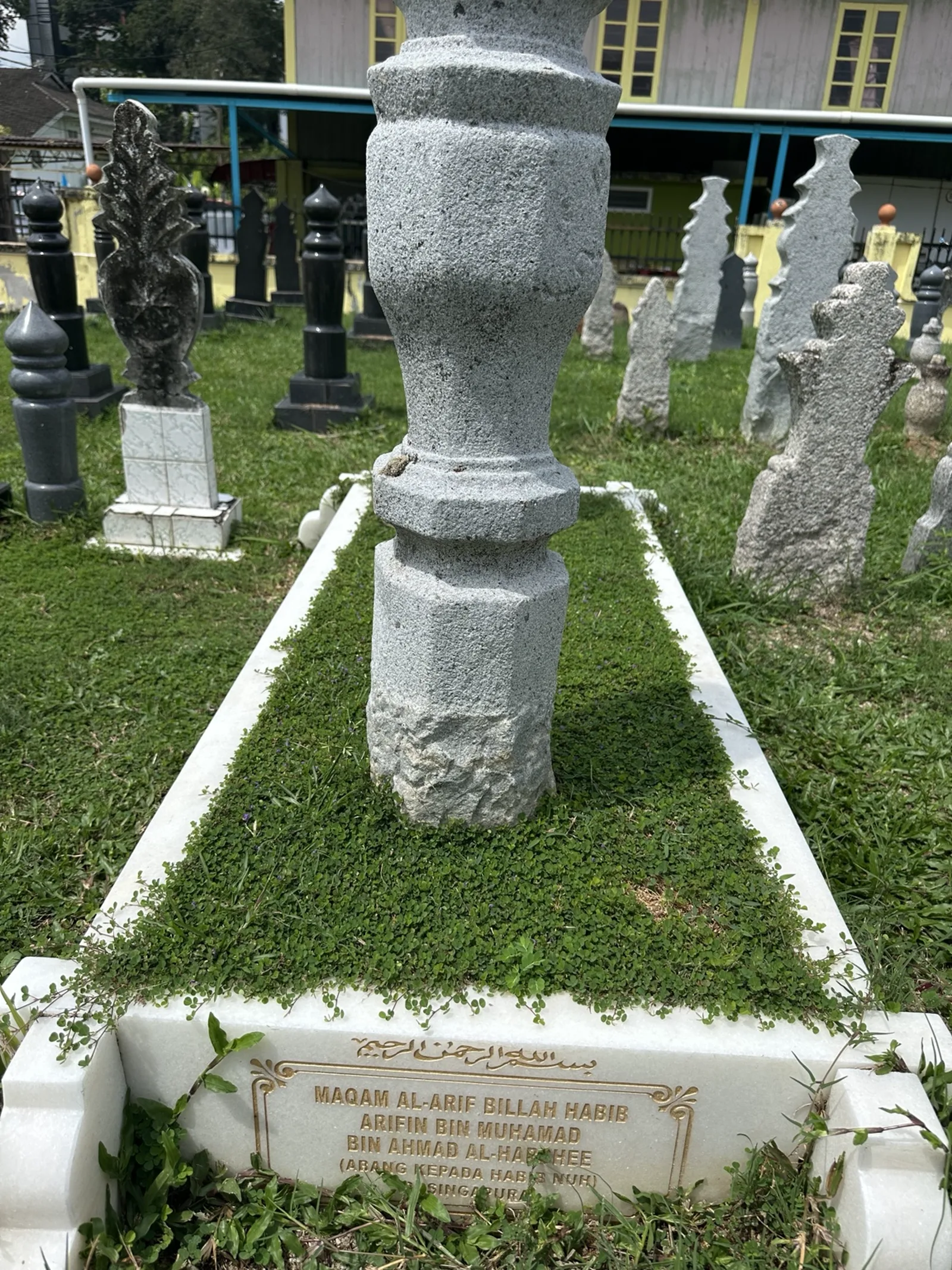
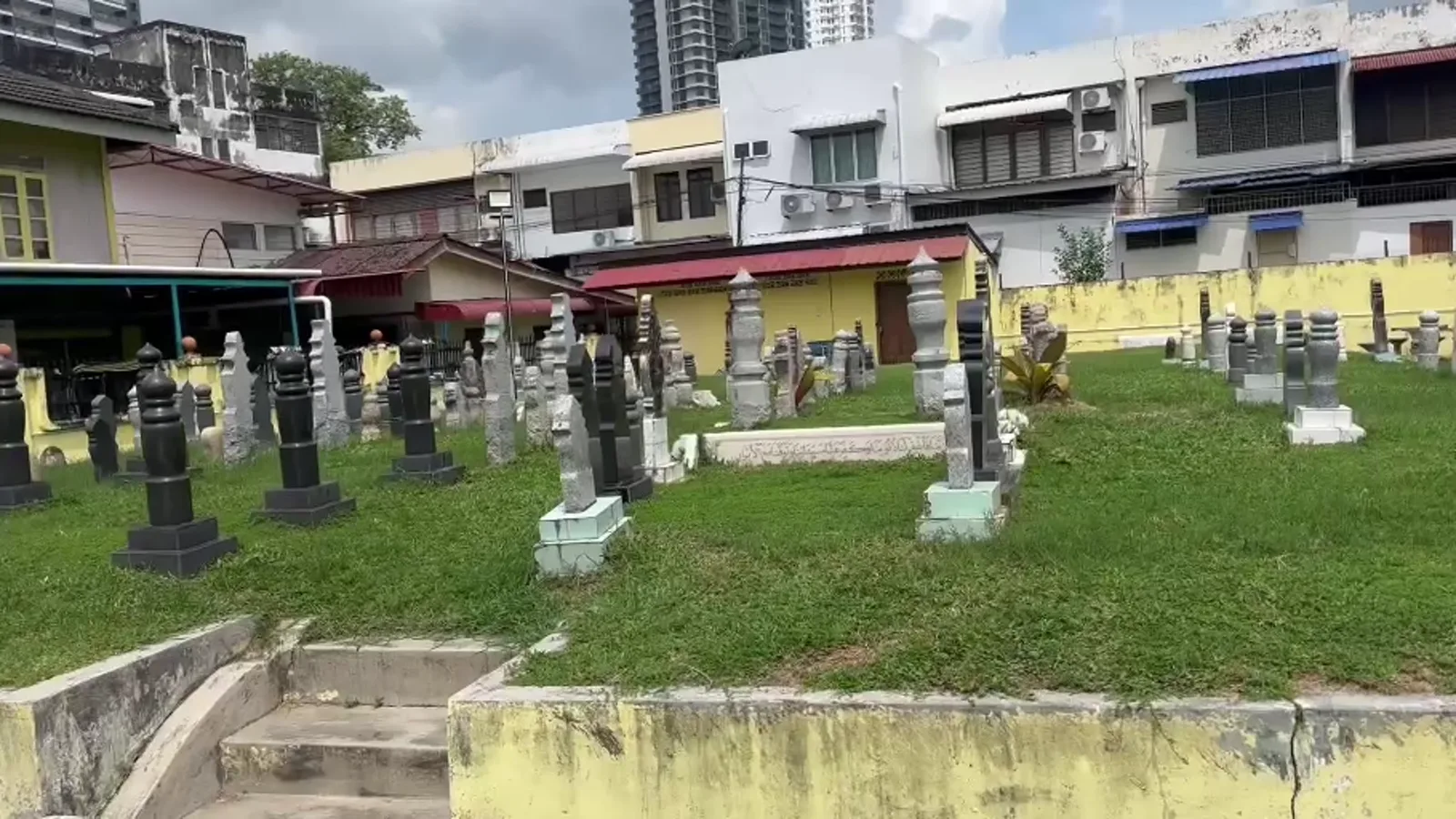
Kak Oja, my cousin, fetched us and, before leaving, took us for one last round of George Town. One of the places she brought us to was an old Muslim cemetery at Kampung Syed, off Lorong Burma.
At first it was simply another stop — a quiet burial ground tucked into the city.
Then I saw one particular grave.
The inscription reads: MAQAM AL-ARIF BILLAH HABIB ARIFFIN BIN MUHAMAD BIN AHMAD AL-HABSHI (ABANG KEPADA HABIB NUH SINGAPURA)
.
Elder brother of Habib Noh of Singapore.
That immediately made this personal in a different way.
Being from Singapore, Habib Noh is a familiar name. His maqam at Palmer Road is part of Singapore’s Muslim heritage. But here I was in Penang, standing at the grave of his elder brother.
It made me wonder: what was Habib Noh’s connection to Penang?
As it turns out, the connection runs much deeper than one grave.
What is Kampung Syed?
Kampung Syed is not merely the cemetery where Habib Noh’s brother happens to be buried. George Town World Heritage Incorporated (GTWHI) documents Kampung Syed and its burial ground near Burmah Road as part of Penang’s Muslim and Arab-Peranakan heritage landscape.
Its Malay heritage booklet identifies the waqf as belonging to Ku Pahmah binti Ku Zainal Abidin, also rendered in historical English spelling as Coopee Ammah. The material records a waqf instrument dated 24 February 1875 and formal administration under the Mohammedan and Hindu Wakaf Board from December 1936. These are the documentary anchors for the place; they do not, by themselves, settle every relationship in the families associated with it.
Who was Habib Noh?
According to the official account of Masjid Haji Muhammad Salleh @ Maqam Habib Noh, Sayyid Noh bin Muhammad bin Ahmad Al-Habshi, better known as Habib Noh, was born in 1788.
That account preserves a tradition that his parents were travelling by sea from Palembang towards Penang when his mother went into labour during a storm. His father made a vow that, if the child was delivered safely, he would be named Noh after Prophet Nuh A.S.
The mosque’s shorter account says Habib Noh came to Singapore in 1819, aged about 31. He lived and died there; the official history dates his death to 27 July 1866. His maqam remains beside Masjid Haji Muhammad Salleh at Palmer Road.
The Penang connection
The official maqam history associates Habib Noh’s father, Habib Muhammad bin Ahmad Al-Habshi, with Penang. It says he worked for the British colonial government, became known locally as Tuan Putih, and that his tomb remains visited in Penang.
Dewan Bahasa dan Pustaka’s PRPM biographical material also says that many of Habib Noh’s relatives lived around the Burmah Road area. This is geographical support for a Penang connection; it should not be turned into a more precise relationship than the source gives.
Habib Ariffin — the grave we saw
Observed directly: the photographed marker names Habib Ariffin bin Muhammad bin Ahmad Al-Habshi and calls him Abang kepada Habib Nuh Singapura
. That is what the marker itself claims, and it is presented here without changing its spelling to make it fit any later account.
Supported by an institutional account: the official maqam history lists Habib Ariffin among Habib Noh’s siblings.
Secondary/local genealogy: PESKAP’s Penang genealogy page describes Habib Ariffin as a senior kadi in Penang and gives his death year as 1904. That is useful local information, but it is treated here as secondary evidence rather than as stronger than the grave itself or the official maqam account.
Family structure according to the official Maqam Habib Noh account
This is one source’s family structure, not an uncontested universal genealogy.
- Habib Muhammad bin Ahmad Al-Habshi (Tuan Putih; associated with Penang)
- Habib Noh bin Muhammad Al-Habshi — later associated with Singapore
- Habib Ariffin bin Muhammad bin Ahmad Al-Habshi — associated with Penang; grave photographed during this visit
- Habib Ahmad Salikin
- Habib Zainal Abidin
The same official account says Habib Noh married Anchik Hamidah of Teluk Ayer Tawar, Province Wellesley, and that their only child was Sharifah Badariyah. It says Sharifah Badariyah married Syed Muhammad bin Hasan As-Shatrie of Jelutong, and that their only child, Sharifah Ruqaiyah, married Syed Alwi bin Ali Aljunied of the Singapore Aljunied family.
This is an important continuation of the Penang story — through Teluk Ayer Tawar and Jelutong — but the details below must be read alongside the conflicting local account.
Where the records disagree
The surviving historical and genealogical accounts do not line up completely. Rather than combine them into a tidy tree, I have kept the versions separate.
1. The Kampung Syed family narrative. GTWHI’s Kampung Syed material identifies Ku Pahmah binti Ku Zainal Abidin as the wife of Syed Mohamad Alhabshee and records a family narrative in which Syed Noh/Habib Noh and Sharifah Aloyah are children of Syed Mohamad’s first marriage, while Ku Pahmah’s later marriage is associated with Syed Zain, Syed Ariffin, Syed Salikin and Sharifah Ghamama. This does not line up neatly with the official Singapore maqam account, which presents Habib Muhammad’s four children as Habib Noh, Habib Ariffin, Habib Ahmad Salikin and Habib Zainal Abidin.
2. Habib Noh’s daughter. The official maqam account names Habib Noh’s only child as Sharifah Badariyah. PESKAP instead records a daughter, Syarifah Madaniah, and connects her to Syed Muhammad bin Hasan Al-Shatiri. The sources therefore disagree on a historically important name and cannot be silently merged.
3. Habib Noh’s birth year and place. The official maqam account gives 1788 and a birth aboard a ship travelling from Palembang towards Penang. PESKAP’s local account gives 1802 and says he was born on the ship of Syed Muhammad Az-Zahir. These details remain unresolved here.
The two institutional sources preserve different versions of part of the family history. This article therefore presents the official Maqam Habib Noh genealogy separately from the Kampung Syed tradition documented by GTWHI. At present I do not have sufficient primary evidence to reconcile the difference confidently.
Kampung Syed account documented by GTWHI
Separate source tradition — do not read this as a continuation of the official maqam tree above.
- Ku Pahmah binti Ku Zainal Abidin / Coopee Ammah
- Syed Mohamad Alhabshee
- GTWHI’s family narrative also names Syed Noh / Habib Noh and Sharifah Aloyah, alongside Syed Zain, Syed Ariffin, Syed Salikin and Sharifah Ghamama in the related household history.
The account is valuable because it preserves the history of the Kampung Syed waqf and community. It is not enough, on its own, to resolve the discrepancies above.
A surname is not a proof
Another Al-Junid name was observed in the cemetery. The official maqam genealogy also contains an Aljunied connection through Sharifah Ruqaiyah’s marriage to Syed Alwi bin Ali Aljunied. It is interesting, but it does not establish any relationship between that particular grave and Habib Noh’s descendants.
What I took away
What I thought would be a quick stop at an old cemetery became one of those unexpected moments that travel sometimes gives you.
A grave in Penang carried the words Abang kepada Habib Nuh Singapura
, and suddenly the histories of Penang and Singapore did not seem quite so separate.
Habib Noh lived and died in Singapore, but Penang runs through much of the story preserved about his family — through his parents, his wider family, Burmah Road, Jelutong, Teluk Ayer Tawar and the people his descendants married.
And here at Kampung Syed, some of that history is still physically present.
I am glad Kak Oja brought us here.
Had she not, I would probably have passed through Penang without ever knowing how close this piece of Singapore’s Muslim history was to the places we had been travelling through all week.
Sometimes a journey gives you something you were not looking for.
Alhamdulillah.
Research & writing note
The visit, photographs, videos and personal observations in this article are Ahmad Ali’s.
Historical research, source comparison, genealogy reconstruction and the historical portions of this article were researched and written with the assistance of Kody (ChatGPT by OpenAI).
AI was used not simply for editing, but as a research and writing assistant. Sources were compared and areas of uncertainty or disagreement have been identified where possible.
Historical genealogy can contain errors, conflicting oral traditions, variant spellings and incomplete records. Readers with primary documents or family records that clarify any of the unresolved relationships are welcome to treat this article as a researched starting point rather than a definitive genealogy.
Sources & further reading
- Masjid Haji Muhammad Salleh @ Maqam Habib Noh — Habib Noh Al-Habshi (principal source for the official family account).
- Masjid Haji Muhammad Salleh @ Maqam Habib Noh — Who is Habib Noh Al-Habsyi.
- George Town World Heritage Incorporated — Muslim Heritage in George Town (Malay edition), especially the Kampung Syed / Kampung Coopee Amah material.
- George Town World Heritage Incorporated — Muslim Heritage in George Town (English edition).
- Dewan Bahasa dan Pustaka / PRPM — Habib Noh biographical material.
- PESKAP — Penang genealogy and grave information (secondary/local genealogical source).